

ERC’s employee engagement surveys give you more than just data—they uncover what’s really going on with your people and what to do about it.
We design and run the survey for you, then deliver clear, realistic recommendations that help you take action, improve engagement, and support performance.

30-Minute Employee Engagement Consultation
Talk through your employee engagement challenges and get practical answers and advice from an expert.

Twelve predictors measured

Thousands of employees surveyed

Three forms of benchmark/comparative data
What’s Included & Measured in our Employee Engagement Surveys
Our employee engagement surveys are built on research-backed questions and proven methods. We measure what actually drives engagement across key areas of the employee experience, using validated tools and a six-point Likert scale that result in reliable, actionable results. Every category we measure is tied to what matters most: helping your people stay connected, motivated, and performing at their best.
Leadership
Job Design & Challenge
Training
Recognition & Rewards
Supervision
Psychological Safety
Coworker Cohesion
Value & Innovation
Performance & Alignment
Growth & Development
Autonomy
Employee Engagement
See a Sample Report
See a sample of our comprehensive Employee Engagement report.
How It Works
1
Meet with us to Discuss Your Organization’s Needs
We meet with you to understand your goals, challenges, and what you hope to learn from your team. Then we tailor the survey approach, timeline, and administration to fit your organization. No cookie-cutter solutions here.
2
We Handle the Details
From launch to close, we manage the survey process so you don’t have to. You’ll get ready-to-use templates to communicate with employees and a simple platform that makes participation easy.
3
Insights and Action Plan
Once responses are in, we walk you through a clear report and review key takeaways with your leadership team. You’ll walk away with meaningful insights, segmented data, and realistic next steps to keep your people engaged and performing.
What Comes After an Engagement Survey?
Once your survey is complete, we don’t just hand you a report, we help you make sense of it. Our team translates the results into clear, practical insights your leaders can act on, highlighting where to focus, what’s working, and what needs attention.
You’ll walk away with a roadmap to improve engagement—not just data, but real direction.
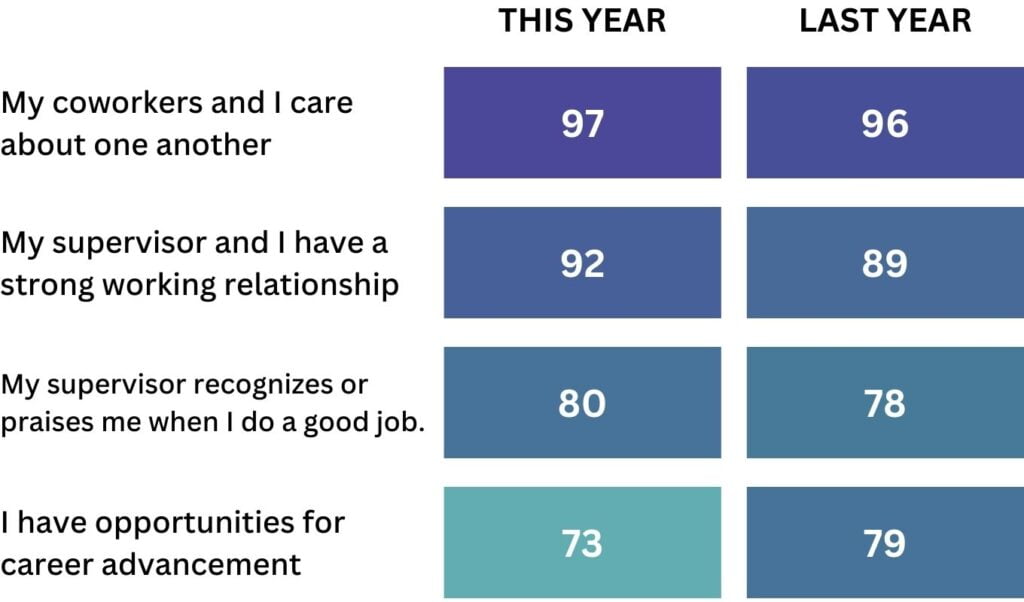
Two Survey Options
Choose the survey size that makes the most sense for your organization. ERC offers two options: a Standard Employee Engagement Survey and a Pulse Employee Engagement Survey.

Employee Pulse Survey
The Pulse Employee Engagement Survey is a shorter version of the standard. This survey takes one item per subscale to gather a snapshot of employee perceptions.

Employee Engagement Survey
The Standard Employee Engagement Survey is a longer survey covering multiple items per subscale to provide your organization with a comprehensive view of employee perceptions.
Why Choose ERC
Track Engagement Trends Over Time
ERC offers an Employee Net Promoter Score (eNPS) to complement your employee engagement surveys. This single metric tracks trends in employee satisfaction, engagement, and loyalty. The eNPS is a simple, yet powerful measurement that gives you a holistic view of the employee experience at your organization between annual or semi-annual surveys. It also helps prevent survey fatigue, leading to increased participation rates.
Easy & Online
We handle all survey administration and related communication with participating employees and our main contact. This includes survey setup, invitations, reminders, and participation updates. We also provide a communication template your organization can customize. It’s used to announce the survey to employees prior to launch to foster understanding and optimize participation.
Interactive Reports
Employee engagement feedback is aggregated into a comprehensive and interactive report, allowing you to select and export different subsets of the data.
In-Depth Analyses
Our Industrial-Organizational Psychologists apply statistical modeling to extract meaningful quantitative and qualitative results.
Data Breakouts
We isolate your data using demographic categories to help
understand if levels of engagement vary by group (e.g., department, location, tenure, etc). You select the categories.
Benchmark Your Results
ERC has some of the most extensive data on employee engagement to benchmark your results against. Our normative database includes responses from ERC engagement survey clients; our one-of-a-kind top-performer database includes responses from top performers at award-winning organizations.
Expert Recommendations & Follow-Up Solutions
Our engagement experts and HR practitioners will study the data and facilitate a review of your results with your leadership team, helping you determine next steps.
Why Employee Engagement Matters
What Can Go Right…

Improved Employee Experience — Understanding the needs and expectations of your team creates a better work environment with higher morale and productivity.
Better Company Culture — Gaining insights into your employees’ values and perspectives can help identify areas for cultural improvement.
More Engaged Employees — By identifying issues that may be hindering engagement, you’ll be able to outline action plans toward a more committed and enthusiastic workforce.
Higher Job Satisfaction — Identify the factors that contribute to employee happiness and fulfillment.
Insights Into Employee Sentiment — Measure the overall mood and attitude of your employees, providing a clear picture of organizational health.
Increased Employee Retention — Identify and address factors that may be leading to employee turnover, helping you retain top talent and reduce recruitment costs.
Gather Honest Feedback — Create a safe and anonymous space for employees to share their feedback, leading to candid and useful data.
Access to Valuable Insights — Uncover patterns and trends in employee behavior and opinions, leading to data-driven decisions that can improve the organization.
What Can Go Wrong…

Decreased Engagement Levels — Low employee engagement can lead to a lack of enthusiasm and commitment to the organization, negatively impacting overall workplace morale.
Employee Well-Being Deficits — Employees who are not engaged often experience higher levels of stress, which can negatively impact their mental and physical health and their contributions at work.
Reduced Team Performance — Low engagement can hinder collaboration and communication within teams, affecting team performance and quality of work.
Increased Turnover — Engaged employees are more likely to stay, whereas disengaged employees are more likely to voluntarily leave the organization.
Decreased Productivity — Disengaged employees tend to be less productive, impacting the organization’s bottom line.
Higher Absenteeism — Low engagement is often linked to higher rates of absenteeism as disengaged employees are less motivated to show up to work.
Challenges in Attracting New Talent — Low engagement can affect an organization’s reputation, making it more difficult to attract top talent.

“ERC is a dynamic, professional organization that provides excellent programs, training, and access to information in a timely, efficient manner.”
– Maria G.

“ERC is my first call for anything that I need help with in the HR space.”
– SueAnn N.

“One of the most valuable things about ERC is they helped us build an initial measurement scorecard, which has evolved so many times over the past seven years.”
– Tony P.
Frequently Asked Questions (FAQ)
An annual survey is common practice, with some companies opting for bi-annual or even quarterly eNPS surveys to monitor engagement levels more regularly.
Employee engagement surveys are important because they provide a comprehensive look at employee engagement levels within an organization. By collecting data on key metrics such as job satisfaction, communication, and work-life balance, organizations can gain valuable insights into the health of their workplace culture. These insights can then be used to make informed decisions that improve employee satisfaction, productivity, and retention. In essence, an employee engagement survey is a vital tool for organizations looking to optimize their workforce and drive success.
Improving staff engagement starts with understanding the drivers of engagement unique to your organization. Once these drivers are identified, they should be incorporated into a comprehensive employee engagement strategy. This strategy may include improving communication channels, offering professional development opportunities, recognizing and rewarding employee achievements, and fostering a positive company culture. Additionally, regular check-ins and surveys can be used to gauge employee engagement levels and gather feedback on what is working well and where improvements can be made. By taking these steps, organizations can create a more engaged and motivated workforce.
As a third party, ERC’s employee engagement surveys are guaranteed to be anonymous. They do not collect any personally identifiable information, ensuring responses cannot be traced back to individual employees. This anonymity can significantly increase the response rate, as employees feel more comfortable providing honest and open feedback.
ERC provides a proven survey template that has been researched and correlated with measuring employee engagement effectively. Our standard questions cover key areas of engagement, and organizations can customize the survey by adding custom questions that reflect organization-specific terminology and analysis by relevant demographic groups. This approach ensures that the survey is reliable and relevant to your organization.
Yes, employee engagement can significantly impact absenteeism. Engaged employees are generally more committed to their work and their organization, and this commitment often translates into better attendance. When employees are engaged, they are more likely to feel a sense of responsibility towards their team and their tasks, which can reduce the likelihood of absenteeism. On the other hand, disengaged employees may lack the motivation to come to work, resulting in higher rates of absenteeism. Therefore, organizations looking to reduce absenteeism should consider investing in strategies to improve employee engagement.
Yes, employee engagement has a significant positive impact on productivity. Engaged employees are more motivated, committed, and invested in their work, which naturally leads to higher levels of productivity. They are likely to put in extra effort, take pride in their work, and aim to exceed expectations. In contrast, disengaged employees may do the bare minimum required, leading to lower overall productivity. Numerous studies have shown a clear correlation between high employee engagement and increased productivity, highlighting the importance of fostering a positive, engaging work environment.
Yes, employee engagement plays a pivotal role in improving retention. Engaged employees, who feel aligned with their career goals and connected to the organizational culture, are more likely to remain loyal to a company. Their emotional and professional investment in the organization means they are less likely to seek opportunities elsewhere. A positive organizational culture that prioritizes employee engagement not only ensures job satisfaction but also nurtures employees’ aspirations and ambitions, further solidifying their intent to stay with the company long-term.
Get Pricing or More Information
Get pricing for ERC’s Employee Pulse or Employee Engagement Surveys. Have questions? Speak with an employee engagement expert to learn more.